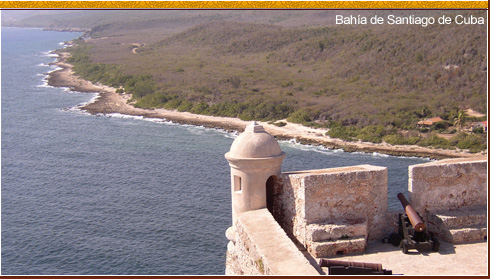
Our congregation begins in 1855 in
Santiago de
Cuba; in order to understand the
spiritual legacy of our founders St.
Anthony Mary Claret and Venerable
Antonia Paris, let us present them to
you.
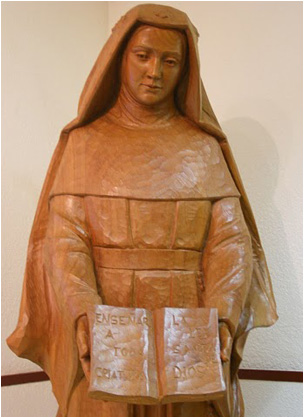
VENERABLE MARIA ANTONIA PARIS
Called by God
Maria Antonia was born on June 28, 1813,
in a small town called
Valmoll, near the northeastern
Mediterranean coast of Spain. Her mother
fled from Tarragona to Valmoll, to
escape the French invasion under the
direction of Napoleon. Her father was a
farmer and died three months
before she was born. Her mother sought
to provide her two daughters
(Teresa and Antonia) a good education in
a Christian family setting.
At an early age, she felt drawn to
prayer. She was
13 or 14 years old when a Franciscan
mission was preached at her
parish. It had such an impact on her
that she decided to dedicate her
life to God.
In generous openness to God's plan
for her, Maria
Antonia felt that God was calling her
to consecrate her whole life to
his service. On October 23, 1841, she
entered as a Postulant in the
Company of Mary, a community dedicated
to prayer and education. At this
time the Church of Spain was under
persecution by the government. In an
attempt to diminish the strength of
Religious Orders, the government
had issued an ordinance prohibiting
the admission of Novices. For this
reason, she had to remain as a
Postulant for nine years. Finally, on
April 21st of 1850, she was able to
begin her Novitiate. Yet, God
seemed to have other plans for her.
Foundress of a New Order
Since 1842, while Antonia was still a
Postulant,
the Lord began showing her a totally
new horizon. She had constantly
prayed for the situation of
persecution the Church was
experiencing in
Spain. To her surprise, God led her to
understand that the ultimate
cause of all these troubles did not
lie in the governments, but in the
Church's lack of faithfulness to the
Gospel. God wanted the Church and
religious orders within it to return
to the lifestyle of the apostles.
Governments opposed the Church because
they coveted the power and
possessions the Church had accumulated
over centuries.
After being confronted with this
challenge, filled with the desire to
live the Gospel with total
faithfulness, she asked God: "how will
I do
this?" The Lord responded: "A new
order I want, not new in its
doctrine, but in its practice." Faced
with such difficult enterprise,
Antonia came to understand that God
did not want her to go about it
alone. Anthony Mary Claret, a well
known missionary priest in northern
Spain, was going to be the one to help
her.
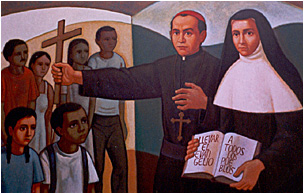
They met in 1850, and after listening
to her, Claret agreed to support
her in this project, which he saw as
coming from God. He had just
recently founded an order of
missionary priests: the Sons of the
Immaculate Heart of Mary, known today
as the Claretian Missionary
Fathers and Brothers.
Months later, after a painful
discernment, she decided to leave the
Company of Mary. She was in the midst
of great confusion because Claret
had been appointed Archbishop of
Santiago de Cuba and had left already
for the new world. From Cuba, he
invited her to start the new order
there. On February 22, 1852, she left
for Cuba with other young women
that decided to join her in the
adventure of crossing the Atlantic to
begin the new order. Claret's
missionary insight, coupled with Maria
Antonia's desire for a life of radical
faithfulness to the Gospel,
converged into a new form of religious
life in the Church.
The new Order at the service
of renewal
Both founders saw the need for renewal
at all levels of the Church, and
they began to design a plan of renewal
"to help the Church restore its
beauty." The new order was to be an
essential element in this work of
renewal, with its testimony and work of
evangelization. Antonia went as
far as sending Pope Pius IX a draft of
her vision of renewal for the
Church, which for her was rooted in a
life of simplicity, joyful
poverty, community, prayer, and
proclamation of the Gospel by all
baptized, but especially by those
consecrated to the service of God.
One hundred years later, the Second
Vatican Council has spoken in
similar terms about the renewal of the
Church.
On August 25, 1855 the new order
-Religious of
Mary Immaculate Claretian Missionary
Sisters- was officially founded in
Santiago de Cuba, as the first
religious community founded on the
island. There was a great need to
educate and promote women, so the new
community opened schools for girls in
Cuba, especially for the socially
and economically disadvantaged. Soon
new communities sprang up in Spain
and other parts of Cuba. The
missionary vision of both founders had
to
adjust to the conditions of the times,
where apostolate for women was
almost restricted to the field of
education. As society and the Church
allowed women to practice other forms
of evangelization, their dreams
for the Congregation have become a
reality.
Antonia spent the last years of her
life in Spain
keeping alive the foundational spirit
of poverty and unity in the new
order. She died on January 17, 1885.
The Church solemnly proclaimed her
heroic virtues on December 23, 1993.
Her remains rest in the chapel
crypt of our house in Reus, Spain,
where she died.
The life and message of Maria Antonia
Paris continue to be a gift for
the Church today. Her insight into the
needs of her time and her
evangelical and courageous response
are sources of inspiration for
every one of us, as we continue
Christ's work responding to the
challenges of our time.
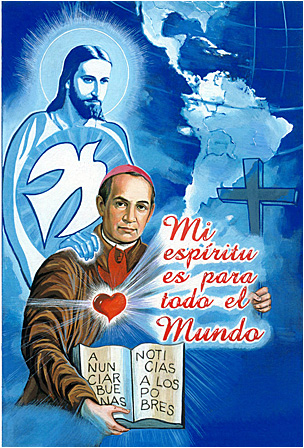
SAINT ANTHONY MARY CLARET
Childhood
St. Anthony Mary Claret was born in
Catalonia, the northeastern corner
of Spain, in a town called Sallent on
December 23, 1807. He was the
fifth son of Juan Claret and Josefa
Clará's eleven children. His father
owned a small textile factory, but is
not rich. Anthony grew up in a
Christian environment, and at a very
early age had a strong sense of
the eternal life that Christ wanted all
men and women to enjoy. He
wanted to spare sinners eternal
unhappiness, and felt moved to work for
their salvation. When he was about
eleven years old, a bishop visited
his school and asked him what he wanted
to be when he grew up. Without
hesitation he responded: "A priest."
Weaver
As soon as Anthony was old enough, he
began working as an apprentice
weaver. When he turned 17, his father
sent him to Barcelona to study
the latest techniques in textile
manufacturing and to work in the large
textile mills. He did so well in the
textile design school that he
began receiving offers from large
textile companies. Even though he had
the talent to succeed, he turned down
the offer and returned home after
experiencing the emptiness of worldly
achievements.
Vocation
The words of the Gospel kept resounding
in his heart: "what good is it
for man to win the world if he loses his
soul?" He began to study Latin
to prepare to enter the Seminary. He
wanted to be a Carthusian Monk.
His father was ready to accept the will
of God, but preferred to see
him become a diocesan priest. Anthony
decided to enter the local
diocesan seminary in the city of Vic.
He was 21 years old. After a year of
studies, he
decided to pursue his monastic
vocation and left for a nearby
monastery. On the way there, he was
caught in a big storm. He realized
that his health was not the best, and
retracted from his decision to go
to the monastery.
He was ordained a priest at 27 years
of age and was assigned to his
hometown parish. The town soon became
too small for his missionary
zeal, and the political situation
-hostile to the Church- limited his
apostolic activity. He decided to go
to Rome to offer himself to serve
in foreign missions. Things did not
work out as expected, and he
decided to join the Jesuits to pursue
his missionary dream. While in
the Jesuit Novitiate, he developed a
strange illness, which led his
superiors to think that God may have
other plans for him. Once again,
he had to return home to keep
searching for God's will in his life.
Missionary priest in
Catalonia and Canary
Islands
Back in a parish of Catalonia, Claret
begins preaching popular missions
all over. He traveled on foot,
attracting large crowds with his
sermons. Some days he preached up to
seven sermons in a day and spent
10 hours listening to confessions. He
dedicated to Mary all his
apostolic efforts. He felt forged as
an apostle and sent to preach by
Mary.
The secret of his missionary success
was LOVE. In
his words: "Love is the most necessary
of all virtues. Love in the
person who preaches the word of God is
like fire in a musket. If a
person were to throw a bullet with his
hands, he would hardly make a
dent in anything; but if the person
takes the same bullet and ignites
some gunpowder behind it, it can kill.
It is much the same with the
word of God. If it is spoken by
someone who is filled with the fire of
charity- the fire of love of God and
neighbor- it will work wonders."
(Autobiography #438-439).
His popularity spread; people sought
him for spiritual and physical
healing. By the end of 1842, the Pope
gave him the title of "apostolic
missionary." Aware of the power of the
press, in 1847, he organized
with other priests a Religious Press.
Claret began writing books and
pamphlets, making the message of God
accessible to all social groups.
The increasing political restlessness
in Spain continued to endanger
his life and curtail his apostolic
activities. So, he accepted an offer
to preach in the Canary Islands, where
he spent 14 months. In spite of
his great success there too, he
decided to return to Spain to carry
out
one of his dreams: the organization of
an order of missionaries to
share in his work.
Founder and Archbishop of
Cuba
On July 16, 1849, he gathered a group of
priests who shared his dream.
This is the beginning of the Missionary
Sons of the Immaculate Heart of
Mary, today also known as Claretian
Fathers and Brothers. Days later,
he received a new assignment: he was
named Archbishop of Santiago de
Cuba. He was forced to leave the newly
founded community to respond to
the call of God in the New World.
After two months of travel, he
reached the Island
of Cuba and began his episcopal
ministry by dedicating it to Mary. He
visited the church where the image of
Our Lady of Charity, patroness of
Cuba was venerated. Soon he realized
the urgent need for human and
Christian formation, specially among
the poor. He called Antonia Paris
to begin there the religious community
they had agreed to found back in
Spain. He was concerned for all
aspects of human development and
applied his great creativity to
improve the conditions of the people
under his pastoral care. Among his
great initiatives were: trade or
vocational schools for disadvantaged
children and credit unions for the
use of the poor.
He wrote books about rural
spirituality and
agricultural methods, which he himself
tested first. He visited jails
and hospitals, defended the oppressed
and denounced racism. The
expected reaction came soon. He began
to experience persecution, and
finally when preaching in the city of
Holguín, a man stabbed him on the
cheek in an attempt to kill him. For
Claret this was a great cause of
joy. He writes in his Autobiography:
"I can´t describe the pleasure,
delight, and joy I felt in my soul on
realizing that I had reached the
long desired goal of shedding my blood
for the love of Jesus and Mary
and of sealing the truths of the
gospel with the very blood of my
veins." (Aut. # 577). During his 6
years in Cuba he visited the
extensive Archdiocese three
times...town by town. In the first
years,
records show, he confirmed 100,000
people and performed 9,000
sacramental marriages.
Confessor to the Queen of
Spain
Claret was called back to Spain in 1857
to serve as confessor to the
Queen of Spain, Isabella II. He had a
natural dislike for aristocratic
life. He loved poverty and the simplest
lifestyle. He accepted in
obedience, but requested to be allowed
to continue some missionary
work. Whenever he had to travel with the
Queen, he used the opportunity
to preach in different towns throughout
Spain. In a time where the
Queens and Kings chose the bishops for
vacant dioceses, Claret played
an important role in the selection of
holy and dedicated bishops for
Spain and its colonies. The eleven years
he spent as confessor to the
Queen of Spain were particularly
painful, because the enemies of the
Church directed toward him all kinds of
slanders and personal ridicule.
In 1868 a new revolution dethroned the
Queen and sent her with her
family into exile. Claret's life was
also in danger, so he accompanied
her to France. This gave him the
opportunity to preach the Gospel in
Paris. He stayed with them for a while,
then went to Rome where he was
received by Pope Pius IX in a private
audience.
First Vatican Council
On December 8, 1869, seven hundred
bishops from all over the world
gathered in Rome for the First Vatican
Council. Claret was one of the
Council Fathers. His presence became
noticeable when the subject of
papal infallibility was discussed, which
Claret defended vehemently.
This teaching became a dogma of faith
for all Catholics at this
Council. The Italian revolution
interrupted the process of the Council,
which is never concluded. Claret's
health is deteriorated, so he
returned to France accompanied by the
Superior General of the Sons of
the Immaculate Heart of Mary, his
congregation.
Last Days in Exile
In France, Claret joined his
missionaries who are also in exile. Soon
he found out, that there was a warrant
for his arrest. He decided to go
into hiding in a Cistercian Monastery in
the French southern town of
Fontfroide. There he died on October 24,
1870 at the age of 62. As his
last request, he dictated to his
missionaries the words that are to
appear on his tombstone: "I have loved
justice and hated iniquity;
therefore I die in exile."
His remains are venerated in Vic.
Claret was
beatified in 1934 and in 1950
canonized by Pope Pius XII.